Varanasi - the city of light
We were on the way to Varanasi in our first Indian sleeper train. We were meant to arrive at nine-thirty am. We arrived at three in the afternoon. We got in the car to get to the hotel. On the way our guide, who came with the driver, told us how high the water of the Ganges (one of the most holy Hindu rivers in India, and Varanasi is the most holy Hindu city in India) had once come. At that time the water was tremendously high covering at least one floor on most houses near the river (and considering that there was an average of fifteen steps on the ghats at the time we were there, that is tremendously high). We got out of the car to walk to our hotel for the last little bit through little side alleys and we saw cows every where(I repeat, this is the most holy Hindu cities, so of course there are going to be cows, they’re the most holy Hindu animal). After we got out of the side streets, we saw the Ganges (or the Ganga as the Indians say) for the first time. It was very wide but we could still see a huge plain which I imagine is completely covered with water directly after the monsoon.
Our guide also told us that the first and the last name of the ghats (varna and assi)were joined together to make varanasi. We went to our hotel which overlooked the Ganges. At night we could see loads of candles floating down the river (they act as a blessing, or something) and we saw people bathing every where. The hotel had free internet access so Bruno spent half his time sittin
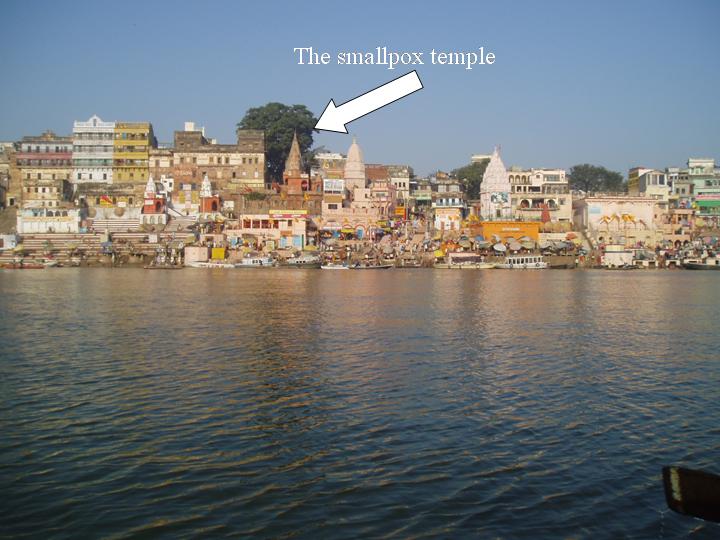 g in front of a computer watching Kids Next Door episodes. After settling in we went on a walk on the ghats (incidentally there are 365 ghats and some people bathe in one each day of the year). We went to a temple down the ghats where the guy said we couldn’t come in because it was “my god not yours”(and the temple policy). We were not unhappy (or at least I was not) because that meant he truly believed in his religion and that he wasn’t tempted by money. It was red and a bit like a Jain temple in its carving. (Later we discovered this temple was for people with smallpox – they think it’s a blessing to have smallpox, like a mark from God)
We went back to the hotel and mum and pup went upstairs to their suite while we were stuck in our average room (meanies). The next day (this is the halfway day) we got up and had a wander through the small side streets again. On the way we met a guy (who later was revealed to be called Beki) who took us along to the burning ghats. We let him because both him and the guide book said people would try to be our guide (without us asking) and then ask for so
 me money, and Beki said that they didn’t bother you so much if you had a guide (because someone else is telling us the stuff so they can’t). And he insisted he would not ask for money. The burning ghats were great ,unfortunately we couldn’t take photos because it was sacrilegious, but I can describe what it looks like (I will describe the process leading up to the burning bodies). Firstly the bodies are wrapped in coloured cloth (there were different colours for male and female but we can’t remember them), then they are dipped in the Ganges. They are then put on their funeral pyre and walked around five times by five of their male relations (the women have to stay at home because they are weak and would cry) The pyre is set alight and the male relations stay until the fire has burnt out (this all happens within 24 hours of dying). We stood next to these very hot bars (from all the fire smoke) watching the dead people burning and the alive and healthy children playing just a ghat down. Other Indian people were bathing some twenty meters away, and on the other side –I told you there were many ghats—women were washing clothes (I hope they didn’t wash our clothes there). The people who are not burnt are a priest, a sadu (a holy man), people with smallpox (because they are already blessed) and pregnant women. They are boated to the middle of the river with a heavy stone tied to them and dumped in the river (where people swim, bath and wash clothes –remember- scary huh?). While we were watching some people came to us with a sad story of their mother or grandmother had died and they needed to buy wood for the funeral pyre. We knew these stories were fake. They warned us in the guide book for it. We saw that at the top of the ghat men were shaved bold because it is a tradition for men who mourn their lost and loved ones. When we were walking away we saw a young, bold, man crying, looking at one of the burning bodies. (even though only the women are meant to cry)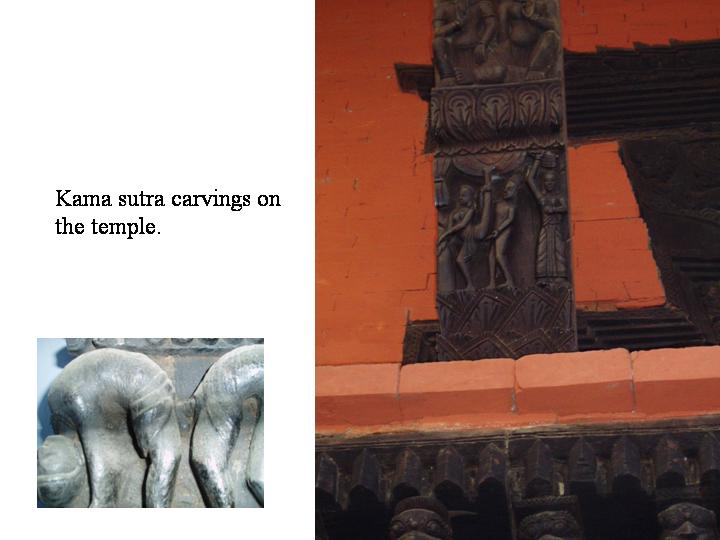
We went to another temple in one of the back allies. It is one of the last remaining Kama Sutra temples. It had lots of carvings of people having sex (and I won’t say anymore or I’ll get in trouble)
We had sent our guide away because we wanted to walk alone –and of course got lost- but after about an hour he ‘accidentally’ ran into in us again, even though we believe he had been shadowing us. He took us to the Golden Temple – which had lots of military guys with guns – because it was next to a mosque so they expected terrorist attacks any moment. And then our guide ultimately brought us to the shop of his father –who had very bad quality fabrics—We got out quickly because we didn’t like it, we didn’t have much time in Varanasi to be polite and the mosquitoes were killing us in that shop. Beki however didn’t give up and took us to the shop of his cousin. Mum ultimately bought some bracelets . Mine broke quickly, so did Bruno’s, but later we repaired t
 hem later.
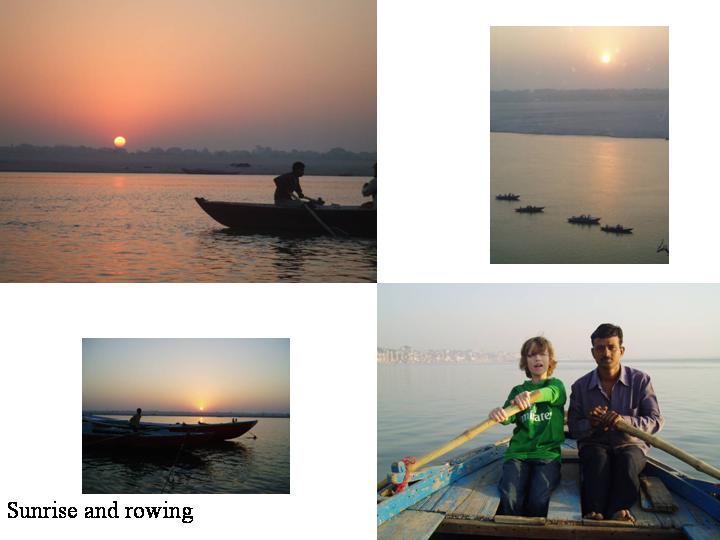
At night we took a rowing boat to see the burning ghats again, and we passed a boat going to dump a body. The boatman let me have a go at rowing, after my courageous but failed attempt, we went to see a festival with chanting monks to celebrate the Ganges. They do it every night and you can see it best from the river. Other boats came up to us trying to sell candles, flowers to throw in the river, and small fish which they just caught and bless you when you put them back in the river (after paying a price first of course). We asked the boatman to come back the next morning (he of course didn’t and when bumped into him at the market he said he slept in).
Anyway, the next morning we got up at sunrise and as soon as we left the hotel Beki came up to us and before he could say a word Ate walked right past him saying “thank you
 we don’t want your ass
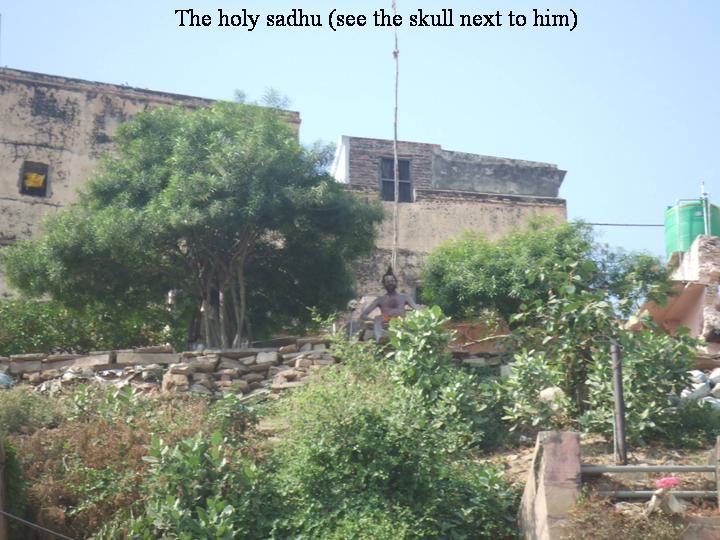 istance”. After some negotiations –you have to negotiate about everything, from bananas to big pieces of furniture—another boatman rowed us on the Ganges. During sunrise we saw millions (actually that’s an exaggeration) of people bathing and washing, and the burning ghat –a smaller one for people with less money—was just starting. Above the ghat was a sadu sitting. His face and body was covered in ashes from the burning ghat below him. Next to him was a skull on a spike. He just sits there all day trying to find a way to enlightenment. Me and Bruno had another go at rowing. It went better than the evening before. After the boatman brought us back, he wanted to take us to the shop of his cousin (Lots of people in India seem to have a cousin, or brother, or father, or sister, or any family member with a shop)
We took a rickshaw to the Monkey Temple, apart from the fact there were no monkey
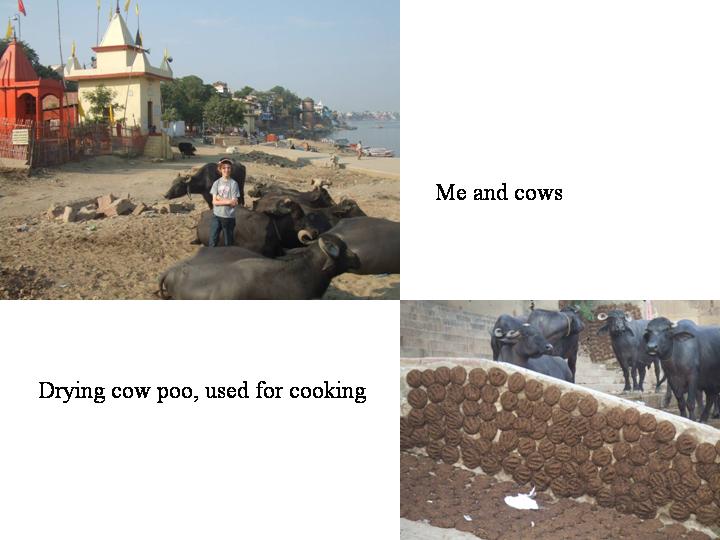 s. The driver, a very skinny man, we were surprised he could pedal the four of us, took us to another temple and there were lots of monkeys. We saw a monkey fight that was probably over territory. They didn’t care that people were around. The rickshaw driver brought us to the very first ghat where there were loads of huge cows. They were properly fed, unlike most cows we had seen in India.We walked along the ghats, avoiding the cow pooh which is being collected and dried for cooking, and passed the place of the sadu again. He didn’t seem to be there so we walked up the steps to see where he had gone, when suddenly he came out of a doorway leading to his sitting place, and he came up to us, cigarette in hand. He was very friendly and said he recognised us from early that morning in the boat (we couldn’t believe it because there are lots of tourists in boats in the morning and it is quite a distance from his sitting place – he must have excellent eyes). He gave me loads of wise advice such as ‘Be yourself, and don’t let others rule you.’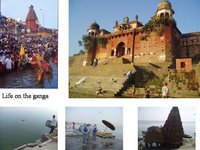
posted by samson at 8:36 PM


2 Comments:
Dear Samson. Another great blog and, presumably, your last, unless you're going to treat us all to a description of the final instalment of your travels. Looking forward to seeing you all - and hearing all about it - soon. love Alice x
9:59 AM
Hi, I am finally allowed on the internet because we are back in gloomy London, so I can post a comment on Samson's blog. He is still catching up - we hope for our sake he will post blogs for all of our travels to India so we can have it as a lasting record of our wonderful journey - but he is a bit behind (it takes a long time to put an entry together and we did not always have easy internet access). We were in Varanasi Nov 18/21 and we left India on Dec 20 so he still has a way to go! Thanks everyone for reading the blog and enjoying it as much as we enjoyed our amazing adventure together.
Libby x
2:23 AM
Post a Comment
<< Home